The School
History
The
school was founded in 1910 as “Yeadon and Guiseley Secondary School” … it
changed its name to AGS in 1937, following the merging of Guiseley, Yeadon and
Rawdon into Aireborough. In 1960 (when our year was in the Lower 6th
form) it celebrated its Jubilee, with a number of events (including a
Thanksgiving Service) and the publication of the “History” by Alan Dobson.
There was another celebration in 1985 to mark the 75th anniversary,
but in 1991 it was closed and its pupils moved to one of the surrounding
comprehensive schools.
More to come.
|
|
|
|
|
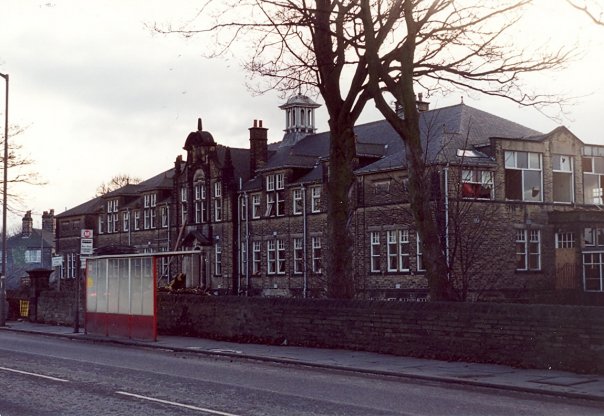
The school as it
was (photo from
Facebook) |
During demolition (photo from
Facebook) |
Also during
demolition (photo from
Facebook) |


While we were there
There
was the main school building, with tennis/netball courts behind it, and
alongside it to the West the “Annex” (rooms X, Y and Z), a pre-fab building
(which was demolished soon after we left and replaced by a multi-storey block.
Behind the school was the netball court, and behind the annex was the hockey
field – also used for cricket practice at times – that we often walked round
during breaks. Nunroyd Park opposite the school was
used for football in winter and athletics and cricket in summer.
Inside
the main building, the top floor held “practical” rooms – Biology, Geography,
Art, Physics and Chemistry labs, and a Domestic Science block – plus the
prefects’ room. The ground floor held the assembly hall, head and deputy and
secretary rooms, and classrooms. In the basement was the swimming pool, gym,
woodwork and changing rooms (and the radio shack, constructed during our time).
Behind
the swimming pool were the cycle racks and the “frog-hole” (when at primary
school, we were told tales of first-formers at Aireborough being dropped down
the frog-hole, and no doubt left there to die a lingering death …).
The
school was divided into four “houses” …
Cavendish (red) Named, I think not for the
scientist but for the Dukes of Devonshire, who owned land around Bolton Abbey.
Coverley (yellow) Commemorates Sir Roger de Coverley, a
fictional character of literary fame, who had connections with Calverley and Esholt. I seem to remember a country dance named after him
(or, after his grandfather of the same name). Read more on Sir Roger de
Coverley | fictional character | Britannica, or about the dance on Roger de Coverley -
Wikipedia.
Fairfax (green) Named for the Parliamentary
General of the Civil War, who had a house at Denton Hall, near Ben Rhydding. Read more on Thomas Fairfax - Wikipedia.
Forster (blue) Named for W E Forster, the Quaker
educationalist who was MP for Bradford (hence presumably Forster Square Station);
read more on William
Edward Forster - Wikipedia. He lived at Lane Head House, in either Nether
Yeadon or Little London, Rawdon (can anyone pin-point that house?).
Academic
and sporting merit
earned “points” for the house, and these accumulated into annual championships,
girls and boys.
There
was a thriving Old Scholars Association (AGSOSA), and while we were in the
Lower 6th they formed a Gilbert & Sullivan Society, with Mrs
Mackay as musical director and Mrs Curry as one of its early producers – that went
by the wonderful acronym of AGSOSAGSS; it later became the Aireborough G&S
society, who still put on performances in Yeadon Town Hall.
What’s left now
The
school site was demolished in 1991 and is now a housing estate. Some of the
stone was reused in the houses. The main entrances were blocked in, and all
there is to see that is noticeably from the old building are the four place
names (Rawdon, Yeadon, Guiseley, Menston
… that used to be high on the walls of the school building) – these are
embedded in the boundary wall facing the A65 road. The roads in the housing
estate are named for two of the “houses”; Coverley Rise, Coverley Garth, and
Fairfax Grove.
Some
of the school furniture and assets were retained. Some of the memorial boards
are on the walls of Yeadon Town Hall : other items
have been saved by David and June Longley, and are stored in Rawdon Library
(you may need to contact them to arrange access) … does anyone know of any other
locations where “assets” are kept? According to a Facebook entry, some things
from AGS went to Benton Park – anyone know what?
Here
are some of the photos of the “remains” …
|
|
|
|
|
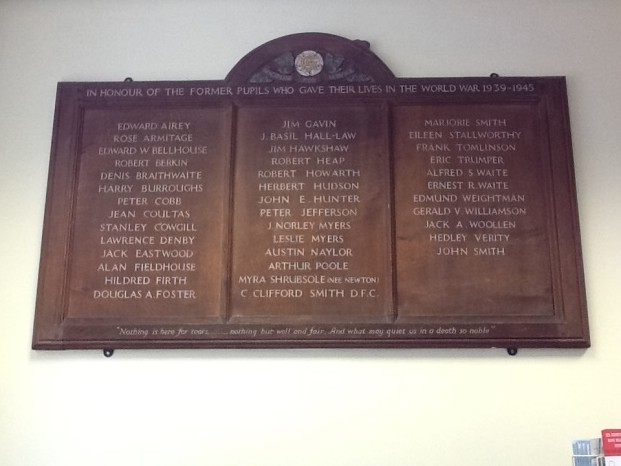
The Roll of Honour
(DL) Originally on the back
wall of the hall. Note the name of
Hedley Verity. |
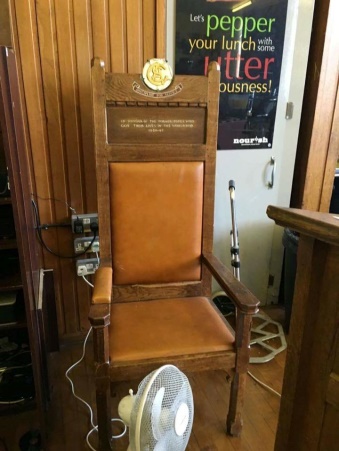
The head’s chair
and lectern (both by Robert “mouseman” Thompson of
Kilburn); photo from Facebook. Sent to Fieldhead
Road school, Guiseley. |
|
|
|
|
|
|
|
|
|
Further Reading
·
Wikipedia
article on AGS: https://en.wikipedia.org/wiki/Aireborough_Grammar_School
·
Facebook
“main” group: https://www.facebook.com/groups/12491975375/ - this is a closed/public group, i.e. anyone
can read it, but you need to “join” the group to add comments or start new
articles.
Return to AGS home page